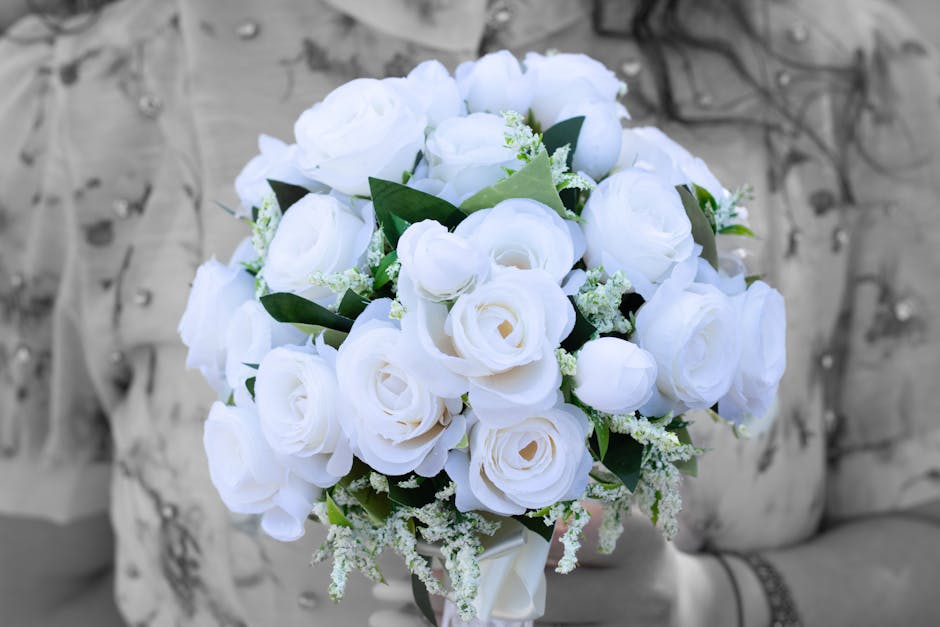
There are four main shapes a bridal bouquet comes in, and a bride who knows what the shapes actually do is in a better position than a bride who leaves the decision to the florist. The four shapes: hand-tied, cascade, posy, and crown. Here is what each one does, and the one you should probably refuse if anybody tries to convince you otherwise.
The hand-tied
A loose dome of flowers, held by the stems, roughly the size of a large grapefruit when viewed from above. The stems are visible and tied with ribbon. This is the default shape for modern outdoor and garden weddings because it does the most work for the least effort.
Why it suits almost everyone
A hand-tied bouquet is held in both hands at waist height, just below the bodice. The round shape echoes the natural curve of the body; the exposed stems break up the mass so it doesn't read as a blob. It flatters slim brides, curvy brides, petite brides, tall brides, and — crucially — brides in pretty much any dress shape from sheath to ballgown.
What to put in it
Three to four focal blooms (peonies or large garden roses), five or six medium blooms (more garden roses, ranunculus), a few sprays of texture (sweet peas, astrantia, scabiosa), and one or two trailing accents for softness (jasmine vine, a short bit of smilax). Nothing more. A hand-tied bouquet looks best when it reads as a small gesture, not as a floral shield.
Size
20 to 25 cm in diameter at the top. Larger and it competes with the bride's face in photographs. Smaller and it looks unfinished.
The cascade
The dramatic shape — flowers mounded at the top with a tapered "waterfall" of trailing stems down the front, sometimes reaching the hem of the dress. Traditional, theatrical, heavy both visually and in the hand.
When it works
Tall brides. Brides in fitted sheath dresses where a round hand-tied would cut the body silhouette in half. Traditional venues — cathedrals, grand manor houses — where the drama of the bouquet matches the drama of the backdrop. Outdoor garden weddings, rarely.
What it needs
A hidden armature (a curved wire form) to keep the shape. Florists' wire for each of the trailing stems because most flowers can't naturally cascade. Plenty of trailing foliage: ivy, smilax, jasmine vine. And focal blooms at the top that hold up to the scale — full peonies, not ranunculus.
The weight problem
A full cascade weighs 1.5 to 2.5 kg by the time all the wire and water-tube support is built in. The bride carries this for the full ceremony and for all photographs. If the bride has small wrists or isn't particularly strong, the cascade will become a problem in the last 20 minutes. Consider a smaller "semi-cascade" (30 cm drop instead of 60 cm) as a compromise.
The posy
A compact round dome, smaller than a hand-tied, held in one hand at waist or lower-chest height. Stems wrapped tightly in ribbon so they disappear under the hand. Victorian, demure, minimalist.
When it works
Small intimate ceremonies. Registry-office weddings. Elopements. Second weddings. Any situation where the bride does not want the bouquet to be a Statement but does want flowers. Petite brides often prefer this — the bouquet stays in proportion.
What to put in it
Tight, even in size. Ranunculus only, say, with a few astrantia sprigs. Or all garden roses in a single colour. The posy shape rewards restraint — a posy with twelve different flower types reads as a missed hand-tied. A posy with three flower types reads as deliberate.
Size
Around 15 cm in diameter. Truly small. Held in one hand, which means the other hand is free for holding the partner's hand, lifting a skirt hem, or holding a glass. This is actually a meaningful advantage for a long ceremony.
The crown
A circle of flowers worn on the head. Not, strictly, a bouquet. We include it here because the florist's work is the same, and because couples sometimes propose adding a crown to the bride's overall floral look alongside a bouquet.
When to refuse the crown
You should refuse a flower crown for your wedding unless you are certain you want one. And you should be certain for the right reasons — because the aesthetic of your whole wedding is clearly bohemian-meadow-folksy and a crown is the obvious completion of that, not because you saw a single wedding on Pinterest and it seemed nice.
Flower crowns date a wedding brutally when they don't fit the context. A fitted cathedral-style gown with a flower crown looks mismatched. A beach wedding with a flower crown can work beautifully. A castle wedding with a flower crown looks like a Renaissance-fair photoshoot.
The other issue: flower crowns wilt under sun and warmth. By 5pm your crown looks tired. If you insist on one, schedule the ceremony for morning or late afternoon, and have the florist bring a spare.
Matching the bouquet to the dress
Some simple pairings:
- Sheath / column dress → hand-tied or small cascade; never a full cascade (cuts the line)
- Ballgown → hand-tied or posy; never a cascade (disappears against the skirt)
- A-line → hand-tied, any size
- Slip / bias-cut → posy or small hand-tied; never a cascade (too much drama for an intentionally minimal dress)
- Traditional lace gown → hand-tied or cascade; posy can look undersized
One more detail
The groom's boutonnière should use one flower from the bouquet, plus a supporting sprig of the same foliage the bouquet uses. Not a miniature version of the entire bouquet. A single ranunculus or a single garden rose, wrapped with a sprig of rosemary or sage, pinned to the lapel. Keep it small — 6 cm.
The short version
Hand-tied for most brides at most weddings. Cascade only if the bride is tall, fit, and the venue is grand. Posy for intimate weddings or second weddings or where the bride wants to keep a hand free. A crown only when the whole aesthetic of the wedding already points there. And a boutonnière that echoes, not mirrors.
Write the first note
Thoughtful disagreement welcomed. Promotional links quietly trimmed.