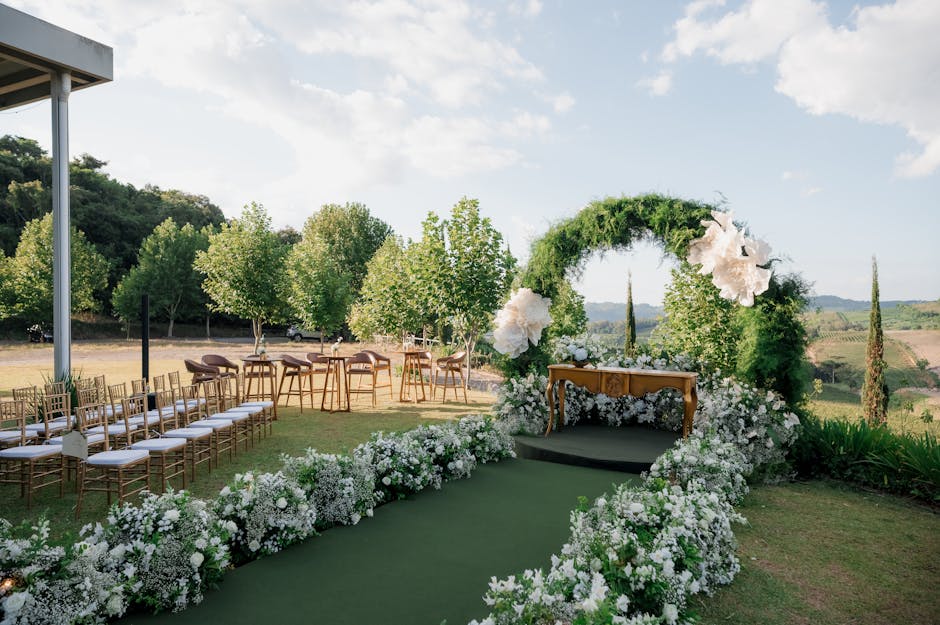
The one thing you can't control at an outdoor wedding is wind. You can check the forecast, pick the sheltered corner of the garden, time the ceremony for the calm of mid-morning, and still find that a 25 km/h gust arrives at the exact moment your celebrant begins the vows. This article is about making sure that gust does not ruin what you built.
What breaks in wind, and what holds
Some flowers are structurally fragile. In a light breeze they shed petals. In a real wind they snap at the neck. Others are tough — they lean, they rustle, they keep their form. Build your ceremony florals around the tough list.
Holds up
- Roses (especially garden roses with tight heads). The petal density means wind slides off the bloom rather than unpacking it.
- Succulents. Obvious, but worth saying: succulents in an arch are indestructible.
- Lavender, rosemary, sage. Fine, wiry stems that bend rather than break. Bonus: wind-crushed lavender smells wonderful.
- Protea, proteaceae generally. Waxy and tough. Good focal blooms for a wind-exposed arch.
- Eucalyptus, ivy, smilax. Foliage with real tensile strength. Forms the structural base of any outdoor arrangement.
- Dahlias, surprisingly. Their heavy heads are supported by woody stems that hold up in moderate wind. Avoid the largest dinnerplate varieties (too top-heavy) — stick to medium-headed cultivars.
Struggles
- Peonies. Heavy head, soft stem. In anything above 15 km/h they nod, then shed.
- Ranunculus. Fine stems, layered heads. Beautiful indoors, fragile outside.
- Sweet peas. The stem is wiry, but the petals are literally translucent. A gust will tear them.
- Hydrangea. Surprisingly bad in wind. The heavy head catches wind like a sail and the stem snaps.
- Anything cut this morning that hasn't had eight hours in water. Freshly cut stems are the most vulnerable — they need time to drink before being put on display.
The arch problem
The wedding arch is the centrepiece of the ceremony and the thing wind most wants to knock over. Two things matter: the base, and what goes on top.
The base
A triangular base is more stable than a square base. Sandbags at each leg — real sandbags, not decorative stand-ins — add 15 to 20 kg at the corners. If the venue permits, stake the legs into the ground with 30 cm metal pegs. If not, stone pavers laid on top of each sandbag add another 10 kg without being ugly.
Height-to-base ratio matters. An arch 2.4 m tall needs a base at least 60 cm square (or triangular with 60 cm legs). Taller than that and you're asking for a catenary failure — the arch pulls itself down sideways in wind. The "just taller than two people" arch is always more stable than the "cathedral height" arch.
What goes on top
Floral on an arch should be asymmetrical, weighted to one corner, not balanced across the top. A balanced top looks like a flower gate. An asymmetrical top, weighted to, say, the upper-right corner with a trailing spill, looks deliberate and more organic.
Use internal wire. Every large bloom gets wire down the stem; every trailing piece of foliage is wired to the arch structure. If you can see wire from three metres away, it's too visible — matt-black or green florists' wire painted to match the arch is ideal.
Trailing ends: weight them. A trailing ribbon flag at the bottom of a wind-catching vine keeps the vine from flagging up and flapping. A small brass weight, or a discreet stone tied into the base of the trailing foliage, settles the whole line.
The ribbon trick
Ribbons on any outdoor floral piece should be weighted at the trailing ends. Unweighted ribbon in wind becomes a whip — aesthetically bad, and actually hazardous near a candle or a guest's eye.
Two ways to weight:
- Knot a small pebble (the size of a cherry) into the hem of the ribbon end. Invisible when the ribbon hangs; stops the ribbon from flagging upward.
- Double-fold the ribbon at its end so the outermost 5 cm is four layers thick. The extra weight damps movement. Less secure than a pebble but no hard objects dangling.
The aisle florals
Ground-level floral arrangements lining the aisle are less at risk than the arch (they're short and heavy), but still subject to wind. Two principles:
- Use wide-based vessels. A narrow trumpet vase will tip. A squat crock, pot, or tin will not.
- Keep them low. Under 30 cm tall. Tall aisle arrangements block sightlines and catch wind.
Place them inside the aisle line, not on it, so a gust that does topple one doesn't land on a guest.
A contingency the florist does
Good florists on windy days carry three things with them on the morning of: a tube of floral adhesive, a reel of thin floral wire, a small bundle of spare blooms in the same palette as the arch. If a section of the arch shifts or a bloom comes loose in the setup window, the whole thing can be repaired in under ten minutes.
Make sure the florist is the last vendor on site the morning of, and that they will stay until the ceremony starts in case a final adjustment is needed. This is one line in the contract worth fighting for.
What to tell the photographer
If wind breaks a section of florals mid-ceremony, the photographer should know to not capture it. A good wedding photographer already instinctively does this — they shoot around a leaning garland until someone fixes it. Still, worth a word in advance.
The short version
Build the arch on a triangular base with sandbag weights. Use tough florals (roses, lavender, protea, foliage) as the bones. Use fragile florals (peonies, ranunculus, sweet peas) only in the bouquets, which you can keep indoors until the last minute. Weight trailing ribbon ends. Keep aisle arrangements low and wide-based. Hire a florist who will stay through setup. And don't check the forecast twenty-five times — you already picked the day. Trust the plan.
Write the first note
Thoughtful disagreement welcomed. Promotional links quietly trimmed.