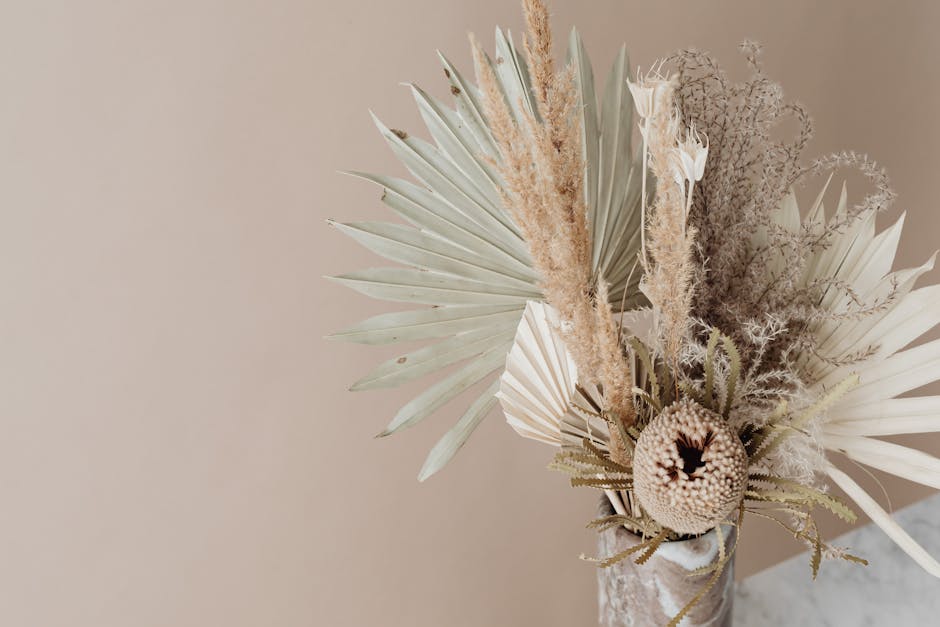
Most dried flower arrangements look, by their second year, like they belong in a basement. Faded, dusty, mouse-coloured, vaguely ashamed. This is usually not the fault of the flowers — it's the fault of choosing the wrong cuts in the first place, keeping them in the wrong light, and never refreshing the bundle. Here is how to choose, keep, and refresh dried florals so they read as deliberate, not forgotten.
The three cuts that age well
Different flowers dry with very different results. Some hold shape, colour, and form for two or three years. Others turn to dust in six months. Start with the good ones:
Silver dollar eucalyptus
The most forgiving. Silver-grey leaves that dry to a slightly paler silver-grey, coin-shaped, matte. It's the workhorse of nearly every dried arrangement that looks good in a magazine. Holds its shape for 2+ years. Holds a faint eucalyptus scent for 3–6 months (the scent fades; the shape doesn't).
Hang upside down in a dark, dry room for 2–3 weeks before use. A kitchen is bad (too humid), a wardrobe is good, a shed is perfect.
Lavender
The flower kings of the dried arrangement. Lavender dries beautifully — keeps its colour for 18+ months if kept out of direct sun, keeps a scent for almost a year. Cut long stems (20+ cm) and bundle loosely with twine; hang upside down for 2 weeks. You can also dry it laid flat on brown paper in a warm room.
The variety matters. Lavandula × intermedia 'Grosso' dries darker and holds scent longest. Lavandula angustifolia varieties dry paler and prettier but lose scent faster. Both are fine. Avoid Spanish lavender (Lavandula stoechas) for drying — the "rabbit ears" shatter.
Hydrangea
This is the surprise of the list, because most dried flowers want to be cut early, while hydrangeas should be dried late. Wait until the flowers on the bush start to take on a papery quality — late summer into early autumn — and cut them then. They essentially dry themselves on the plant.
Put the cut stems in 2–3 cm of water in a vase and leave them. As the water evaporates, the flower dries in place, keeping its shape. Takes 3–4 weeks. Colour shifts from fresh blue/pink/purple to a muted vintage-looking tone of the same colour. Lasts 2+ years.
The two cuts that age badly
Roses
The common advice is "dry a rose by hanging it upside down" — and yes, it will dry, but almost all roses dry to a brown-red or dusty-tan that doesn't match anything in the room. They also shed outer petals constantly. You can dry a rose. You shouldn't.
If you have a particular rose that's sentimental and needs preserving, press it flat between the pages of a heavy book for 3 weeks. Framed, a pressed rose keeps a flat memory of its colour. A hanging-dried rose is just a browning mess.
Daisies (and most small-headed flowers)
Daisies shatter. You lift one, the petals fall off individually. Every time. The same applies to chamomile, cosmos, most small daisy-family flowers, and alstroemeria. Don't try to dry them.
Where to display dried florals
Light is the enemy of dried colour. UV light bleaches dried flowers at roughly three times the rate of visible light. A dried arrangement in a sunny south-facing window will look tired in four months. The same arrangement in a north-facing hallway will look fine at eighteen months.
Good rooms
- Hallways (usually low-light)
- Bathrooms with good ventilation (surprisingly — steam dissipates faster than you'd think)
- North-facing bedrooms or studies
- Kitchens away from the sink and the steam
Bad rooms
- Any south-facing room with direct sun
- Sunrooms, conservatories (both light and humidity)
- Kitchens directly over the sink
- Rooms with forced-air heating vents blowing directly on the arrangement (shatters brittle stems)
The six-week rebundle
Even a good arrangement starts to look tired around the six-week mark. Petals relax, colour flattens, the arrangement looks slightly sad. You don't need to throw it out — you need to refresh it.
How
- Take the whole arrangement out of its vessel.
- Lay it on a large sheet of brown paper. Look at it as a collection of stems, not as a finished thing.
- Swap half the stems. Pull out the tiredest 50% (look for shattered edges, brown tips, discolouration). Replace with fresh dried stems from your "spare" bundle (see below).
- Re-bundle loosely, varying heights. Put the tallest new stems at the back. Put the freshest-looking blooms at the front.
- Return to the vessel.
You've just refreshed the arrangement without buying anything new. Do this every six weeks.
Keep a "spare bundle"
Every time you dry a batch, dry twice as much as you need. Tie the extras into a loose bundle and store flat in a drawer or box with a silica packet. Use them for the rebundling pass. When the spare bundle runs out, you buy or dry more.
Displays that don't scream 2008
A few quick rules on styling, specifically to avoid the era-specific look:
- No mason jars. Use ceramic vessels, brown glass, unglazed terracotta, or a single brass urn. Mason jars with dried flowers dates a room immediately to a specific decade.
- No rustic tags, twine bows, or price-tag labels. Tying a paper tag to a dried arrangement is the visual signal of "farmhouse" in the 2015 sense. Let the arrangement speak for itself.
- No baby's breath as a main ingredient. As with fresh arrangements, baby's breath as the primary flower reads as wedding-recovery. A small accent in a larger dried arrangement is fine; the whole vessel being baby's breath is not.
- Loose is better than tight. A tight bouquet held stiffly upright reads as commercial. A loose spray that falls slightly to one side reads as deliberate.
The short version
Eucalyptus, lavender, hydrangea. Avoid roses and daisies (the first browns, the second shatters). Keep out of direct sun. Rebundle every six weeks with swap stems from your spare bundle. No mason jars, no twine tags, no baby's breath. Loose over tight. A dried arrangement styled this way will look considered at year one and year two.
Write the first note
Thoughtful disagreement welcomed. Promotional links quietly trimmed.