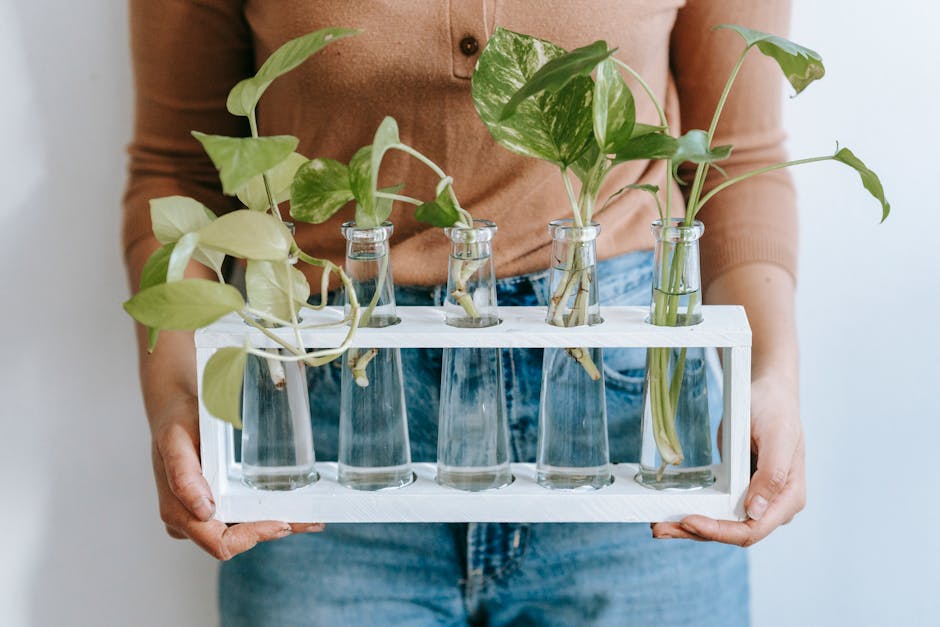
Most interior-design photography of indoor climbing plants features a conservatory — full southern exposure, 20-foot ceilings, the vine reaching a skylight. Most houses are not that. The good news: four species forgive low light, irregular watering, and average ceilings. You can grow a convincing climbing garden in a rented flat with a single north window. Here is how.
What forgives
Pothos (Epipremnum aureum)
The one everyone starts with, for the right reasons. Tolerates low light, inconsistent watering, moderately dry air, and short periods of neglect. Variants to look for: golden pothos (classic), neon pothos (lime-green — bright, cheerful), marble queen (variegated white-and-green, the most elegant), and the Cebu blue (silvery-blue tint, an actually surprising colour).
Grows quickly. You'll see 15–30 cm of new vine per month in good conditions. Tolerates bad conditions by slowing, not by dying — a pothos in low light still grows, just 5–8 cm per month.
Where: any room that gets even indirect light. A bathroom with an obscured-glass window. A hallway. A corner of a study.
Heart-leaf philodendron (Philodendron hederaceum)
Often confused with pothos — similar leaf shape, similar growth habit. Key difference: philodendron has heart-shaped leaves that come to a distinct point; pothos has wider, slightly asymmetric leaves. Heart-leaf is slightly more shade-tolerant than pothos.
The bonus: if you cut a long vine and want to replant, philodendron roots faster in water than pothos (visible new roots in 3–5 days).
Hoya (Hoya carnosa and H. kerrii)
Succulent-stemmed vines with waxy, oval leaves. Slower growing than pothos — 5–15 cm of new vine per month. In exchange: it flowers. Clusters of small, fragrant star-shaped flowers, once a year, usually in summer.
Hoya wants a bit more light than pothos (bright indirect rather than low). It also wants to dry out between waterings — in fact, it prefers being slightly underwatered. If you are the kind of plant-keeper who forgets to water, hoya is your plant.
Where: a bedroom near an east- or north-facing window. A kitchen shelf that gets morning light. Don't put it in direct afternoon sun — the leaves will burn.
String of pearls (Senecio rowleyanus) — with a caveat
Not technically a climber — it trails. But if you want something that cascades dramatically, string of pearls is the one. Round green bead-leaves on long strands.
The caveat: it needs bright light. A south- or west-facing window, or a supplementary grow light. In true low-light conditions it will limp along but look tragic within a few months. If your house doesn't have a single bright window, skip this one.
What doesn't work in a house without a conservatory
String of hearts (Ceropegia woodii)
Will technically survive in moderate light, but looks leggy and sparse. Wants real sun to be beautiful.
Monstera deliciosa in vine form
A mature monstera is not really a climber in the sense of pothos — it's a structural plant that wants a moss pole. It also wants warm rooms (over 18°C), real humidity, and consistent bright indirect light. A flat that drops to 14°C in winter will stunt it.
Orchids on any support
If someone sells you "climbing orchid" setups, back away. Orchids are not climbing plants in any meaningful sense and the care they need is entirely different.
Trellis setups, without damaging the wall
You can get the climbing-plant look without drilling holes or taping anything to the paint.
The bamboo stake approach
Put a 1.5m bamboo stake into the pot when you plant. As the vine grows, wind it around the stake. You'll need to train it every 2–3 weeks in the growing season — gently wrapping new growth around the stake rather than letting it flop. Invisible fishing line can be used at key points if a section refuses to stay wrapped.
The stake should be taller than you expect. A vine will outgrow a 1m stake within a year.
The fishing-line wall climb
For a climb up or across a wall without screws:
- Attach two 3M Command hooks (the removable kind) at the points where the vine should start and end — a few feet apart, at roughly the height you want the vine to travel.
- Run clear fishing line or thin invisible thread between the hooks.
- As the vine grows, tie new growth loosely to the line with small loops of the same thread.
Visually, the line disappears within a metre. The wall looks like the vine is climbing on nothing. If you ever move out, the hooks come off the wall with a gentle pull.
The brass hook on the ceiling
For cascade plants (hoya, string of pearls, trailing pothos), a single brass hook in the ceiling above where a bookshelf or side table sits lets you hang the pot from the ceiling and let the plant fall. Use a proper ceiling hook rated for the plant's weight + pot + wet soil weight (usually 3–5 kg total).
Which room for which plant
- Bathroom (high humidity): pothos, heart-leaf philodendron. Both love it. String of pearls hates it.
- Bedroom (usually lower light, cooler): pothos, hoya (near a window), philodendron.
- Kitchen: pothos on a high shelf — but keep away from the stove (heat and grease both damage leaves).
- Living room with a sunny corner: hoya, string of pearls.
- Hallway: pothos. Pothos will grow in a hallway with almost no direct light, slowly and steadily. Perfect for the kind of corner you walk past every day without thinking about.
Watering, without a schedule
Don't water on a calendar. Water when the top 3–4 cm of soil is dry to the touch. For pothos and philodendron, this is usually every 7–10 days. For hoya, every 12–18 days. For string of pearls, every 14+ days.
Signs of underwatering: leaves drooping, slight yellowing. Easy to reverse with a good deep watering. Signs of overwatering: yellow leaves that feel soft, smelly soil, root rot. Harder to reverse and more likely to kill the plant. When in doubt: underwater.
The short version
Pothos and heart-leaf philodendron in most rooms. Hoya for a bright window with a flower bonus. String of pearls only if you have genuine light. Use a bamboo stake or fishing line on Command hooks to train the climb without damaging the wall. Water when the top 3 cm of soil is dry, not on a schedule. This is a climbing garden in any house.

Write the first note
Thoughtful disagreement welcomed. Promotional links quietly trimmed.