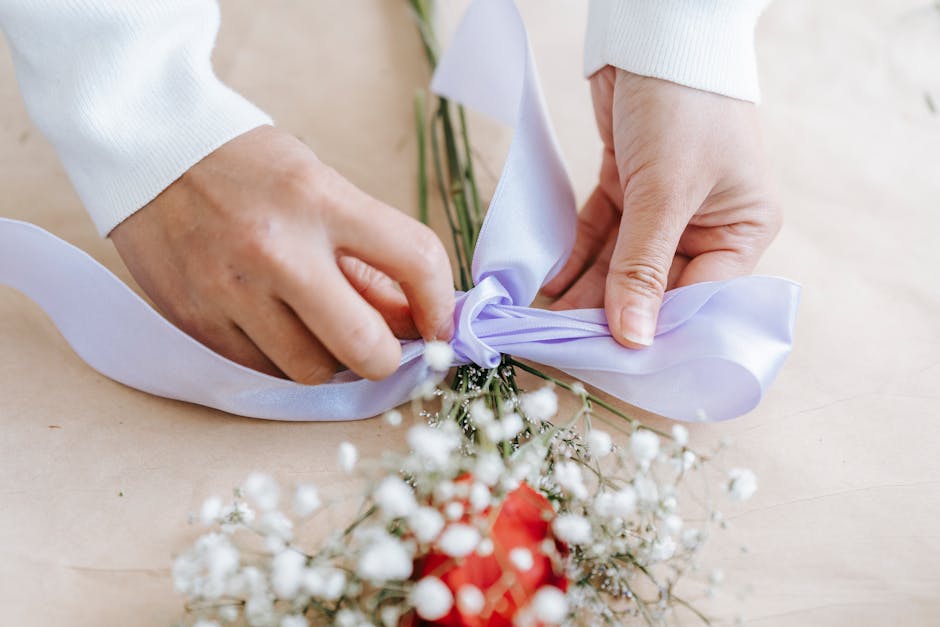
Most ribbons on most bouquets are doing too much. They are either visibly knotted (the knot becomes the thing your eye lands on first) or they are gift-wrapped in that stiff factory bow which reads as supermarket the moment you see it. A real florist ties a ribbon so you barely notice there is a ribbon at all — and then, an hour later, you do notice, and it looks like the flowers grew a ribbon on purpose.
Below is the knot, plus the four decisions that matter more than the knot.
First, pick a ribbon that knows its place
The ribbon has one job: hold the stems together and let the blooms be the thing you remember. Which means:
- Silk satin in a muted tone — oyster, dusty rose, a terracotta that matches the clay pot you are about to put this in. Avoid high-shine satin: it reflects too hard in photos and looks like a prom corsage.
- Hand-dyed bemberg or cotton if you want a more artisanal feel. The slight color variation reads beautifully against wildflowers.
- Velvet if the arrangement is for an autumn or winter table. Velvet reads as cold weather on every other season.
Width: 1 to 1.5 inches (25 to 38 mm) for garden-bouquet sized arrangements. Narrower and the ribbon disappears; wider and it dominates. For a small nosegay, drop to 5/8 inch (15 mm).
Length: at least triple the circumference of the bouquet at the tie-point. You want two trailing tails that can reach the bottom of the stems.
Second, pick a tie-point that makes sense
The common mistake is tying the ribbon right under the heads, which shortens the visible stem and makes the bouquet look stubby. Tie the ribbon two-thirds of the way down the stems, closer to where you would naturally hold it. The stems above the tie stay visible, and the cluster of blooms looks tall, not crammed.
Mark the tie-point with your thumb before you start.
Third, the knot that does not look like a knot
This is called a half-hitch with a trailing tail. It is not fancy. It just doesn't read as a gift bow.
- Hold the bouquet in your non-dominant hand, thumb on the tie-point.
- Drape the ribbon across the front of the stems at the tie-point, leaving roughly one-third of its length trailing on the left side and two-thirds on the right. The shorter tail will be the anchor; the longer tail will be the one you work with.
- Pass the long tail behind the stems, to the left.
- Bring it forward across the front, crossing over the short tail.
- Tuck it up and under, behind the crossover, and pull downward. You now have a tight half-hitch.
- Do not tie a bow. Let both tails hang.
If the ribbon is slippery (silk satin tends to slide), repeat steps 3–5 one more time — a double half-hitch holds overnight. For cotton or velvet, the single hitch is plenty.
Fourth, the trim that finishes it
Cut both tails at different lengths. Same-length tails look corporate. Different-length tails look hand-done. The shorter tail should reach about mid-stem; the longer tail should graze the bottom of the stems or hang just below them.
Cut on a diagonal for satin and bemberg (prevents fraying-up). For velvet, a clean straight cut is fine — velvet doesn't fray meaningfully.
What to do if the knot still reads like a knot
You can soften any knot by pulling both tails gently apart in opposite directions right after you tie it. This flattens the knot into the stems rather than letting it sit proud. The knot goes from looking like a button to looking like a pleat.
If the ribbon still draws the eye, your ribbon is too bright. Swap it for something quieter. No ribbon can be both loud and correct at the same time.
When to skip the ribbon entirely
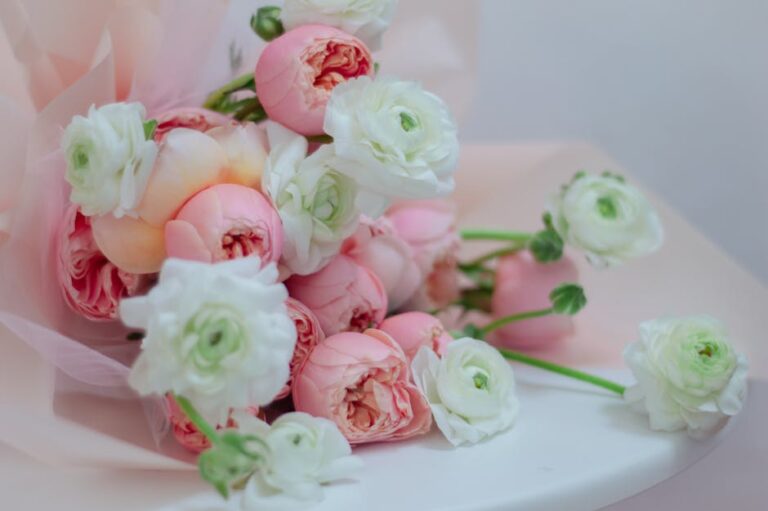
Twine. Plain butcher's twine, natural-color. A kitchen-garden bouquet — lavender, rosemary, whatever is in the herb bed — looks more honest with twine than with silk. A weeding-day bunch of daisies wants twine, not oyster-satin. The rule: match the ribbon's formality to the flower's formality. A ranunculus wants silk. A field daisy wants string.
The short version
Ribbon in a muted tone. Tie two-thirds down the stems. Half-hitch, no bow. Different-length tails, diagonal cuts. If it reads as a knot, soften it. If the knot still talks, your ribbon is wrong. Pick again.
Good luck.
Write the first note
Thoughtful disagreement welcomed. Promotional links quietly trimmed.