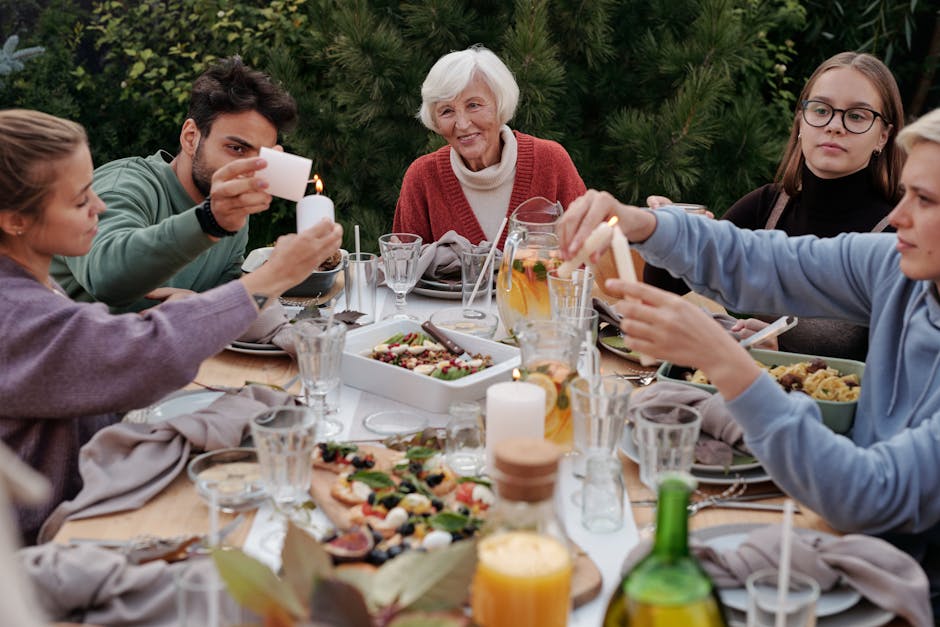
There are three mistakes people make lighting an outdoor dinner, and all three are about height. Lanterns hung too high. Candles at the wrong spacing on the table. Accent lighting that comes from the wrong place and blinds the people it's meant to flatter. Fix those three and the evening works.
Lanterns at chest height, not overhead
The instinct with string lights is to hang them high — six or seven feet up, draped across trees, over the heads of guests. This is fine for the first ten minutes (looks romantic in photos) and bad for the rest of the evening. Light from overhead casts shadows straight down a face, which means dark circles, shadowed eye sockets, and everybody looking slightly tired.
The fix: hang the string of lights at chest height, not head height. Around 1.2 metres off the ground when a guest is sitting. This sounds wrong. In practice it reads like candlelight — soft light coming from roughly where a candle would sit, not from above. Faces soften.
Yes, people will bump into the string once or twice. That is the price of correct lighting.
If you can't lower the string
Hang the lights as high as you have to (structural constraints, tall-guest constraints), but then add a second line of lanterns at chest height along the perimeter. Battery-LED pillar lanterns work. Glass hurricanes with tea lights work. The point is that SOMETHING is lit at chest height.
Candles spaced 45 to 60 centimetres apart on the table
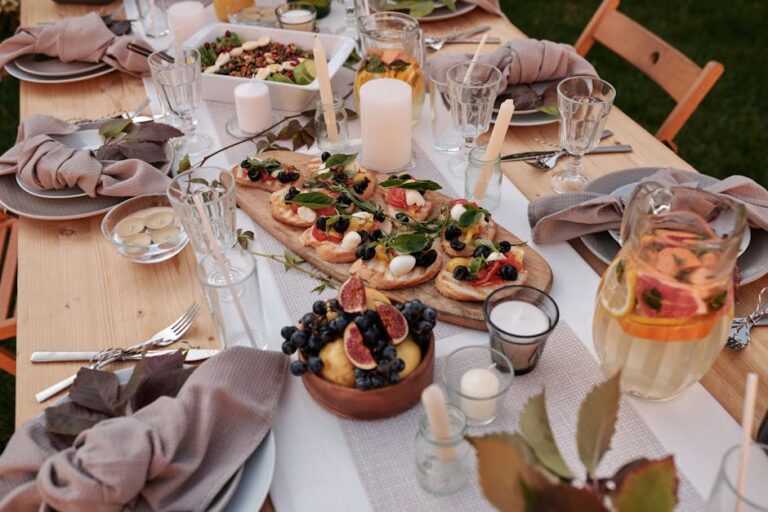
Closer than 45 cm and the table reads overlit (like a restaurant). Further than 60 cm and there are dark patches between the candles where the food looks unappealing. The sweet spot is roughly one taper per place setting, slightly staggered from the plates so the flame doesn't sit in anyone's direct eye line.
The height matters too
Tapers should be between 20 and 30 centimetres of remaining candle above the table surface at the moment of lighting. Shorter and they're done by dessert; taller and they're at seated eye level, which is distracting.
Light them half an hour before dinner so the wax softens and starts to weep. A freshly-lit candle reads as prop; a half-hour-in candle reads as dinner.
Avoid citronella at the table
The scent of citronella reads as camping equipment at exactly the wrong moment. If you genuinely need mosquito deterrent, put the citronella candles at the perimeter of the garden, ten metres from the table, downwind. The smell should reach the table as the faintest possible suggestion, not as a room scent.
For table-level, use beeswax. Beeswax releases a faint honey scent as it burns that doesn't compete with food. Rapeseed is also fine. Soy is neutral but a little waxy-smelling. Paraffin is fine and cheap but doesn't smell of anything.
Brass in summer, copper in autumn
Candleholder material matters more than you'd think. It reflects light back onto the table surface, which colours the food.
- Brass is warm gold. Flatters most summer food: salads, grilled fish, fruit. Best match for natural linen.
- Copper is warmer still, tips orange-pink. Flatters autumn: roasted vegetables, squash, rust-coloured florals.
- Silver is cool. Best for indoor winter dinners where everything is already warm-lit. Outdoors in summer it looks too formal.
- Pewter and iron are dark. They absorb light instead of reflecting. Fine as accent pieces, bad as primary candleholders.
Perimeter lighting: low, warm, minimal
The space outside the table matters. A completely dark garden around a brightly-lit table looks like a stage. Add:
- Two or three lanterns on the ground at the edge of the garden, maybe by the path or near a hedge. Light spilling upward makes the garden itself feel alive.
- One warm-bulb fixture on the house or shed wall, dimmer turned low. Enough to see when walking to the table, not enough to read by.
- Nothing blue-toned. No cool-white string lights. Check the colour temperature on any LED — 2700K or warmer is the only acceptable range. Cooler than that and the garden reads as a parking lot.
What NOT to light
Do not light the faces of your guests directly. Spotlights, up-lights pointed at where people sit, strong downlights from a tree over the table — all of these put too much light on the face, and faces under strong light look tired. The table should be bright, the edges warm, the faces in a gentle halo of candlelight.
Weather: when battery-LED is acceptable
In high wind, real candles won't hold. Glass hurricanes help, but if you're at 30+ km/h gusts, you'll spend the evening relighting. In that case: battery-LED tea lights inside the hurricanes, real candles in a sheltered cluster (e.g. the centerpiece). Nobody can tell when the glass is hurricane-warm. Only use LEDs that are dim and warm-toned. The bright white ones are indistinguishable from a bike light.
The short version
Lanterns at chest height, tapers at 45–60 cm spacing and 20–30 cm above the table, brass in summer and copper in autumn, no citronella at the table, warm perimeter lighting around 2700K, and no direct face light. Get those right and everyone at dinner looks twenty percent better than they did when they arrived. This is worth more than any other piece of furniture in your garden.
Write the first note
Thoughtful disagreement welcomed. Promotional links quietly trimmed.